The Gadget
American PrometheusThe Gadget was the first Atomic bomb built at Los Alamos and tested at Trinity on July 16, 1945. More than a device, it stood at the meeting point of improvised wartime construction, scientific collaboration, and a weapon whose consequences could not be contained within the laboratory that made it. Its completion became inseparable from J. Robert Oppenheimer’s leadership; its existence forced its makers to confront what the weapon could mean for the world beyond the test site.
A weapon and the laboratory that made it
The Gadget took shape within the Manhattan Project, whose demands required Oppenheimer to become a kind of director he had never been before. At thirty-nine, he had to gather scientific work scattered across distant sites, organize it into a usable weapon, and adapt to administrative routines and security rules that felt alien to him. The project ran on a schedule too compressed for any part of that transformation to proceed comfortably, but Oppenheimer came close to meeting it.
The choice of Los Alamos brought the weapon’s production to a remote mesa in New Mexico. Oppenheimer knew the country from horseback trips through the Jemez Mountains and had wanted to combine his interest in physics with the high desert. General Leslie Groves secured an isolated site, served by a winding gravel road and a single telephone line. Construction crews put up inexpensive barracks and makeshift chemistry and physics laboratories, all painted Army green. The striking landscape and the rudimentary settlement were not incidental surroundings: the laboratory had to be built in parallel with the work it was meant to support.
That work began amid severe logistical shortages. John Manley contrasted Los Alamos with Chicago, where a major university, libraries, machinists, glass-blowers, and engineers were already available. At the new site, the initial resources included little more than the remains of the Ranch School and its horseback-riding equipment, neither of which could supply the needs of experimental physics. Oppenheimer concentrated on recruiting scientists while the community and laboratory were still being assembled. The Gadget thus emerged not from a finished industrial setting but from a hastily created one, where scientific ambition depended on building the practical conditions for research at the same time.
Trinity and the object on the tower
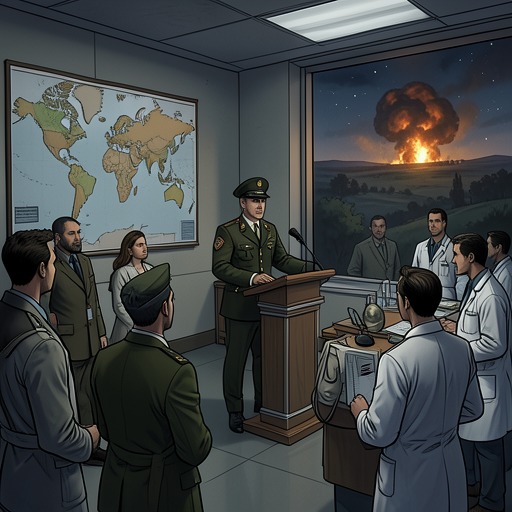
The Gadget’s decisive public moment came at Trinity, the test of July 16, 1945. A photograph caption places Oppenheimer in his porkpie hat, leaning over the device atop the test-site tower only hours before the explosion. The image fixes the director beside the object at the threshold between preparation and detonation: a weapon that had occupied a remote, tightly organized project was about to become a historical fact.
The device’s completion was also a collective achievement. Hans Bethe, who had known Oppenheimer for three decades and worked at Los Alamos, later credited him with bringing out the best in the scientists he led rather than dictating what they should do. Bethe and other Los Alamos veterans believed that without Oppenheimer the Gadget would not have been finished in time for use in the war. The laboratory’s diverse scientific group had been forged into an efficient team, and the weapon’s timely completion depended on that organization as much as on individual expertise.
From technical achievement to moral dispute
The Gadget’s significance did not end with the test. As the war in Europe appeared to be nearing its end, Los Alamos scientists increasingly discussed what the weapon would mean after the war and how it might be used. Informal conversations in apartments gradually gave way to meetings in lecture rooms. Victor Weisskopf recalled that Oppenheimer opposed organizing such discussions, arguing that decisions about the weapon’s use were political rather than the scientists’ task. Yet Oppenheimer also appeared at a March 1945 meeting of about forty scientists on the bomb in world politics. Robert Wilson remembered him offering cogent arguments to a room of people who doubted that the weapon would be used against Germany but did not know what should happen instead. These recollections differ in emphasis, but together they show that the Gadget was already a source of conflict within the laboratory before its first test.
Other remembered discussions addressed whether using the weapon against living people could be right, and whether it might end war even as it condemned its makers to perpetual fear. No official records were kept of these sensitive exchanges, so the history of the debates rests on later recollections. The absence of minutes leaves no single authoritative account of what was said; it also underscores how the device’s political and moral implications pressed against the secrecy of the project that produced it.
The weapon beyond Trinity
In the years that followed, the Gadget became the point of departure for arguments about a far more powerful thermonuclear weapon. In 1949, Oppenheimer and the General Advisory Committee warned that a Super with a potential yield of 100 million tons of TNT, compared with 15,000 tons for the Hiroshima bomb, might destroy 150 to 1,000 square miles or more. They feared that such a weapon would have no appropriately sized military target and could become a weapon of genocide. Their objection was not simply that the weapon would be destructive: they argued that possessing it could damage American security by convincing other nations that the United States contemplated annihilating civilian populations.
Oppenheimer and the committee proposed refusing to build the Super, while maintaining that the existing stock of atomic bombs could make retaliation effective if the Soviet Union developed one. They also argued for producing smaller tactical weapons and strengthening conventional forces in Western Europe, a strategy aimed at nuclear sufficiency rather than an ever-expanding stockpile. This position carried its own danger. In the Project Vista report, Oppenheimer supported tactical weapons as aids to battlefield forces, a shift from his earlier warning that atomic weapons expressed total war. The prospect that battlefield use could trigger a wider nuclear exchange went unaddressed in that argument. From the tower at Trinity to later disputes over arsenal size and battlefield strategy, the Gadget’s legacy was therefore not a settled technical accomplishment but an enduring question about what military and political order would be built around the weapon.